How the he*k do I get ROI from conferences
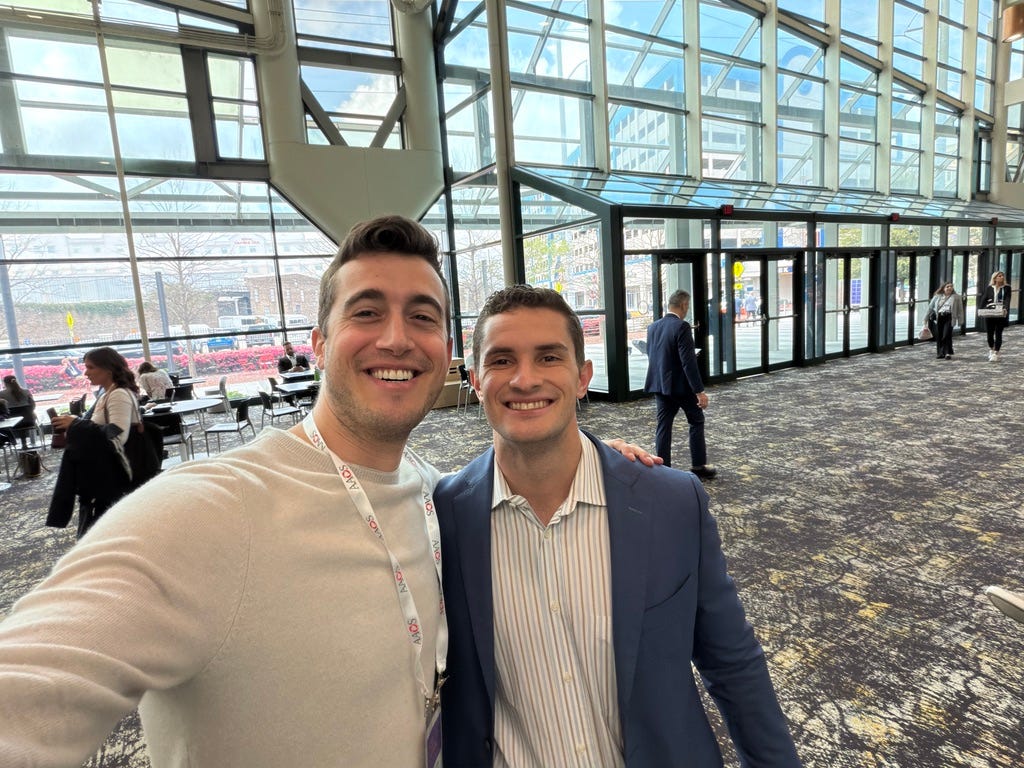
A few months ago I flew to New Orleans for the American Academy of Orthopaedic Surgeons annual conference (AAOS). 30,000+ attendees, hundreds of exhibitors, and my willpower to talk to real decision makers who don’t reply to email or Linkedin because half these people are surgeons or medtech reps who haven’t updated their profile since 2019.
This is the reality for a ton of vertical companies. Your buyers aren’t hanging out on LinkedIn. They aren’t opening cold emails. They’re in operating rooms, on job sites, in clinics, in warehouses. The playbook that works for selling dev tools to Series B startups in SF doesn’t work here.
But you know where these people DO show up? Industry conferences. And if you build an actual system around conferences instead of just buying a booth and crossing your fingers, this channel can be absurdly productive.
However, if you plan effectively and have a strong strategy going into these conferences, most of the time, they’re a complete no brainer. So let’s talk about it.
Why Conferences Hit Different for Vertical SaaS
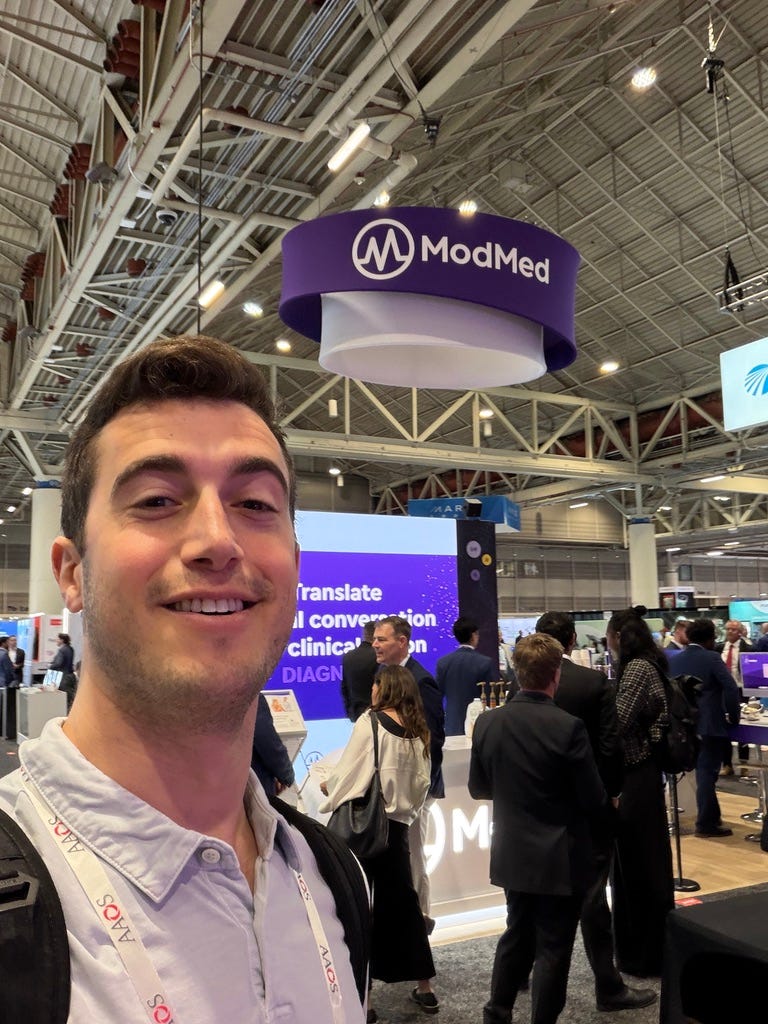
There’s a reason event organizers say in-person events are their most impactful marketing channel. For vertical companies specifically, conferences solve the two hardest problems in your GTM simultaneously: access and trust.
Access - your buyers are unreachable through normal channels. They don’t live on LinkedIn, they don’t read cold emails, and they might not even have a public-facing email address. But they DO attend their industry’s annual conference because their peers are there, the latest products are there, and their company pays for it.
Trust - in verticals like medtech, construction, manufacturing, etc., buyers are deeply skeptical of outsiders. They’ve been burned by vendors who don’t understand their world. A 15-minute conversation at a booth where you demonstrate real domain knowledge does more than 50 emails ever could.
The math is simple: if your average deal is $50K+ and you can close even 2-3 deals from a $15K conference investment (booth + travel + dinners), that’s a 6-10x ROI. But only if you have a system.
Goes without saying - do not buy the $500,000 booth - it’s not a good use of your $3M seed round ;)
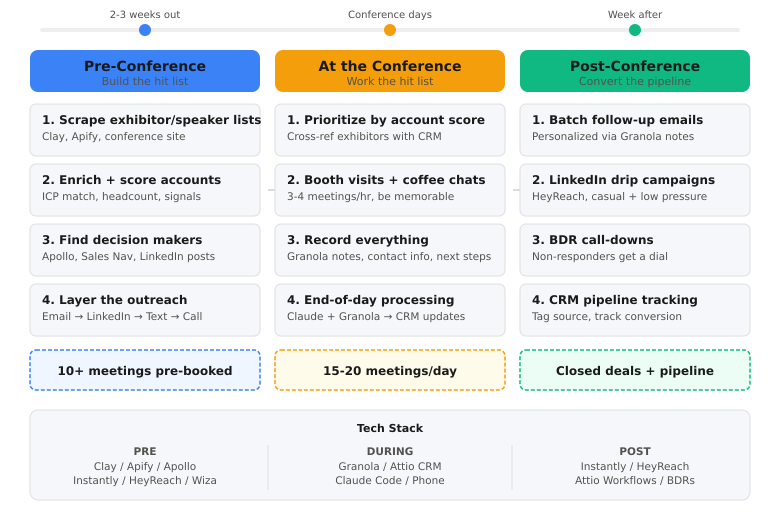
There’s effectively 3-4 touchpoints you can have with folks in your end-market associated with a conference
Pre-Conference Outreach
Email
Call
Text
IRL Conference chats
At the booth
Coffee chats
Hosting events or going to events
Post Conference Outreach
Email
Call
Text
How I do it - Before the Conference
Here’s the actual workflow I run for pre-conference prospecting:
Scrape the exhibitor/speaker list - Most conference sites have an exhibitor page. Use Apify or Clay’s Chrome extension to pull every company name. If there’s an attendee list available for purchase, buy it - it’s almost always worth the $500-2K.
Enrich the companies - Run the company list through Clay or your enrichment stack. Pull headcount, revenue range, tech stack, whatever your ICP criteria are. Score them the same way you’d score any account.
Find the right people - For your top-scored accounts, find the decision makers using Apollo, LinkedIn Sales Nav, or your data provider of choice. You want 2-3 contacts per account ideally.
LinkedIn stalking - Search LinkedIn for posts mentioning the conference name. People literally announce they’re going. These are warm targets. Save them.
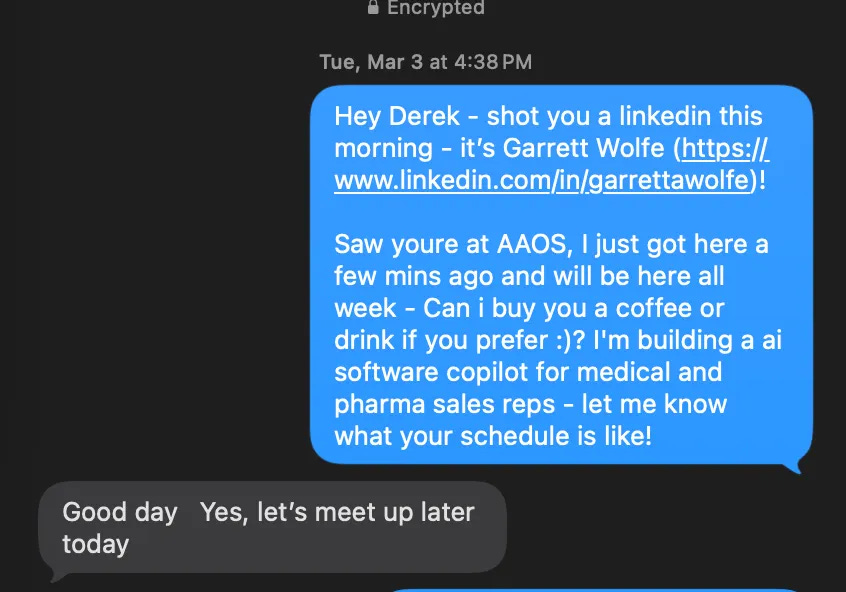
Layer the outreach - Email first (2-3 weeks out), then LinkedIn request with a note (1-2 weeks out), then if you have phone numbers, text or call the week of. The text play is genuinely underrated - I sent ~30 texts for AAOS saying something like “hey, just got into NOLA for AAOS - would love to grab coffee if you’re around” and booked 10 meetings from it.
At the Conference
This is the fun part → in life if you have real chutzpah, you can do some incredible things. For most people its too easy to send an email, and tons of folks aren’t as good at a nice cold-approach. I am no pro, but if you can get over your fear of going up to random strangers at conferences and asking them about their problems, you can pretty much do anything in this life.
Prioritize Your Hit List
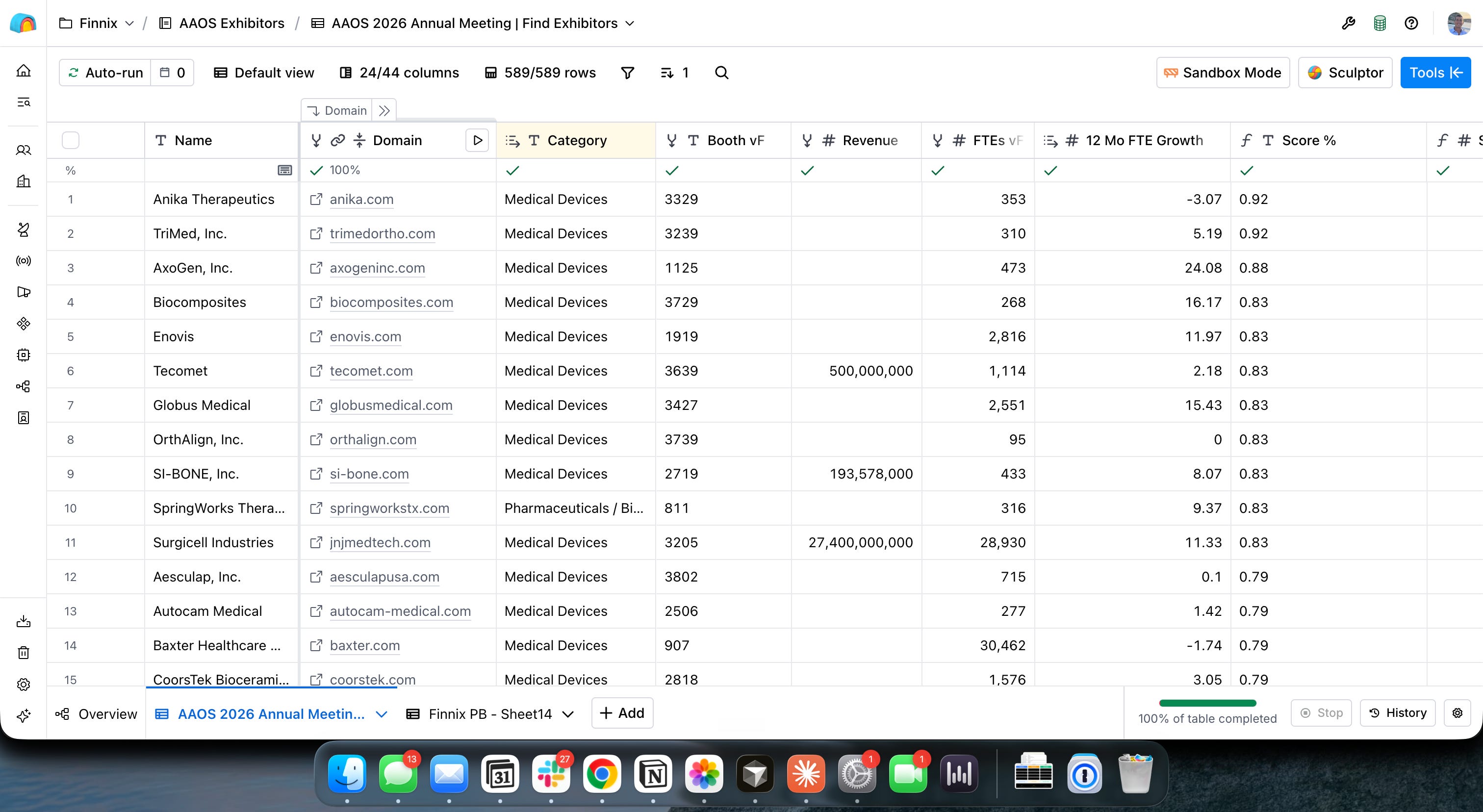
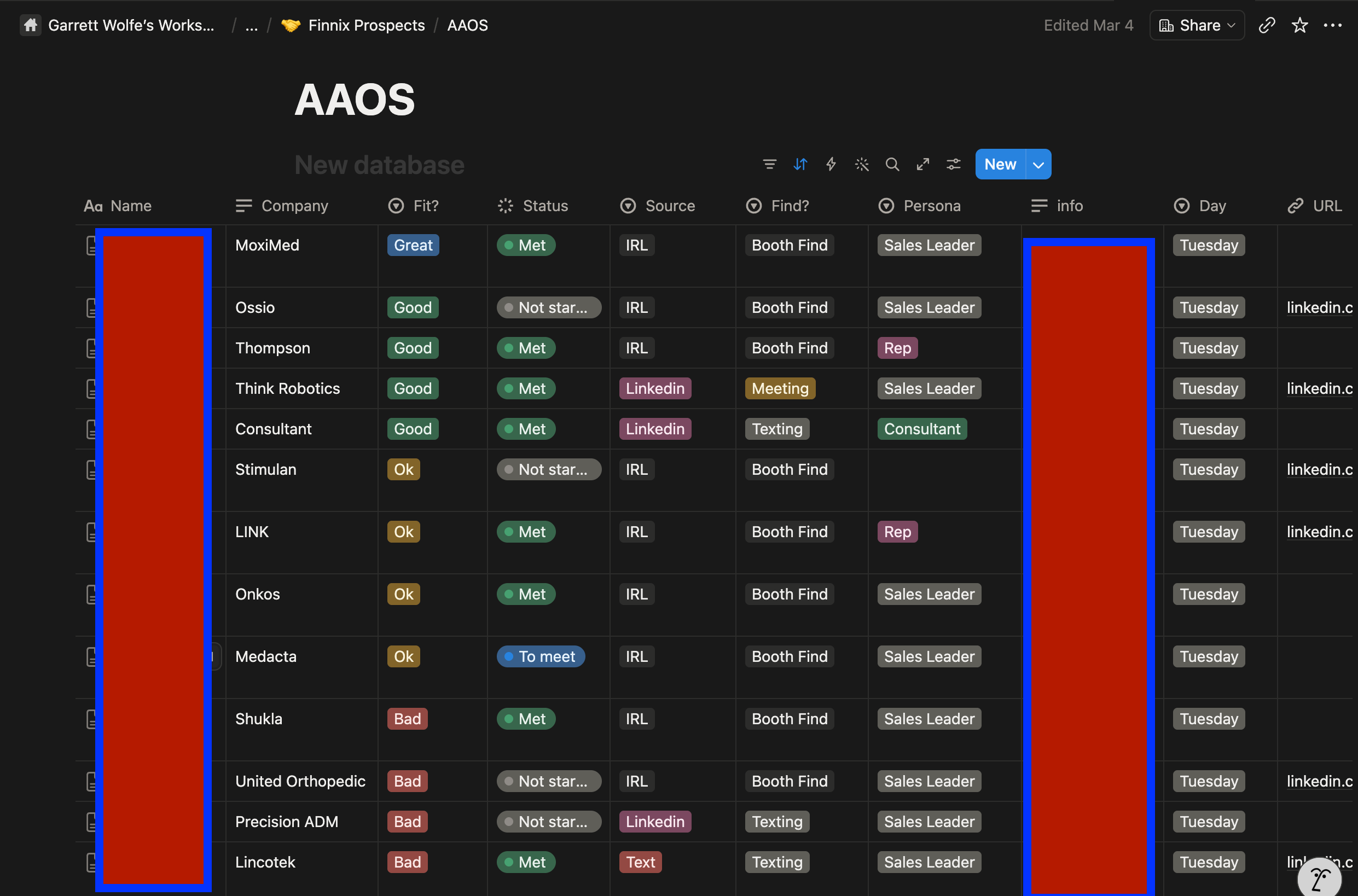
However, just approaching anyone is not good enough, you could waste the entire conference going up to accounts that are too small and don’t have budget, or are too big and have built your product in-house. You need to be far more strategic. When i went to AAOS, I took the exhibitor list I captured above, and cross referenced it with my CRM to see the approximate account score for each of the accounts. Then I sorted the list by descending account scores so I could see each company I should go visit, and i could concretely see why → they have 25+ field sales reps, they have 15 managers, they recently were acquired by a PE firm, etc. Going up to an account like this one rather than approaching an account that has a nice booth but no reps in the USA will yield far different results and will allow for your boots on the ground efforts to be fare more worthwhile.
The Approach
Before you approach the booth, try to do a cheeky Linkedin stalk to identify your buyer beforehand if you can. And glance at the firmos / technos so you can use some good references during the chat.
Record Everything (if you can)
Finally, be sure to record the conversation via Granola or otherwise if you can, and get their email / phone number and land some concrete next steps if they’re interested/
At the same time, you’ll be able to have those coffee chats that you scheduled, same logic applies. Do a pre-read on the company, record the convo and summarize it, and get followup contact info if needed.
Finally, go to a few events / happy hours / meals and try to be friendly and meet others.
Build in Real Time (Yes, at the Conference)
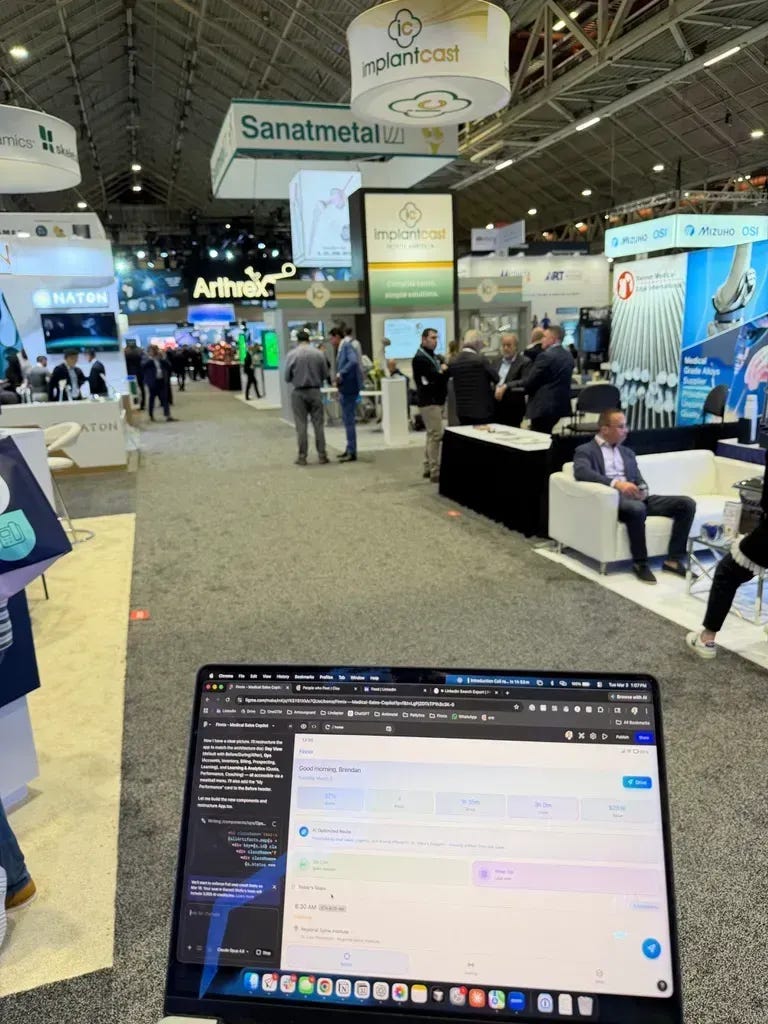
One thing I did at AAOS that I think more founders should try: I brought my computer and Figma Make with me to the floor. Not on a monitor at a booth - on my laptop, between meetings.
I’d be talking to a prospect at their booth and they’d say something like “I wish this could show me X instead of Y” or “what if the interface did Z.” I’d thank them, walk to the next booth, and prompt Figma Make to render what they just described as I was walking. By my next coffee chat I had an updated prototype that reflected real buyer feedback from 60 seconds ago. That’s an insane loop. The traditional version of this is: go to a conference, take notes, fly home, debrief with your product team, wait two weeks for a design update, then try to re-engage the prospect who’s already forgotten your name. I compressed that into the time it takes to walk across a convention center.
And look - a lot of people will tell you it’s “too early” to go to a conference. You don’t have product-market fit yet, your prototype is rough, you don’t even have a sales deck. I’d push back hard on that. I went to AAOS specifically because I was early. I wanted to compress months of customer discovery into three days of face-to-face conversations with the people who actually live the problem I’m trying to solve.
You can do 50 Zoom calls over 2-3 months or you can spend 3 days at the industry conference and learn more than you would in a quarter. The prototype doesn’t need to be polished - it needs to be a conversation starter. If anything, showing something rough makes people MORE willing to give you honest feedback because they feel like they can actually shape it. The worst thing you can do is wait until you think you’re “ready” and miss a year’s worth of conferences where your buyers were all in one building waiting to tell you what they need.
How Many Meetings can i get?
If you do all of the above and are able to prioritize accounts and all the tech necessary to have these meetings and make them productive, during a 5 hour conference day (10AM - 3PM), you should be able to have one meeting every 15-20 minutes, or 3/4 per hour. So 12-16 meetings each day if you eat lunch and 15-20 meetings each day if you don’t ;)
Moreover, your goal should be to be an extremely memorable individual - wear a funky shirt or make a lot of jokes - you’ll need your prospects to remember you - if they don’t your post-conference outreach will go nowhere.
At the end of each day, you can have Claude ingest all of your Granola notes, the contact info, and more and 1) update CRM, and 2) send those annoying follow up messages
Post Conference Outreach
Arguably the most annoying part of the process, but where actual conversions happen → if you aren’t nailing the post conference playbook - you might as well have not gone or spent the money to do so.
Drop everyone into some friendly, casual, and low pressure followup campaigns via email, and Linkedin. And have BDRs follow up with anyone via email and phone that doesn’t reply. Be sure to reference tangible points you touched on at the conference.
The Math on Conference ROI
Let’s be real about costs. A typical conference booth for a startup runs $5-15K depending on the show. Add flights, hotels, dinners, and swag and you’re looking at $15-25K all-in for a team of 2-3.
That sounds like a lot until you do the math. If your ACV is $30K+ and you close even 2 deals from a conference (which is very achievable with this playbook), you’re looking at a 2-4x ROI. If your ACV is $100K+ it’s a no-brainer.
The key metric I track: cost per qualified meeting. If I’m spending $20K total and I’m having 40 meaningful conversations across 3 days, that’s $500 per qualified meeting. For most vertical companies where CAC runs $5-10K+, that’s extremely competitive with every other channel.
The conferences where ROI breaks down are the ones where teams don’t do the pre-work, don’t have a hit list, and don’t follow up. They spend $20K to have 5 random conversations and wonder why it didn’t work.
Worst case, it’s a good team bonding event with customer feedback from real buyers that will give you something to think about when you go back home!
Quick note: you don’t need a booth to run this playbook. Some of the best conference ROI I’ve seen comes from teams who just buy a general admission pass, have a killer hit list, and spend 3 days doing coffee meetings and walking the floor. The booth helps (it gives people a reason to come to you), but it’s not required. The system is what matters.
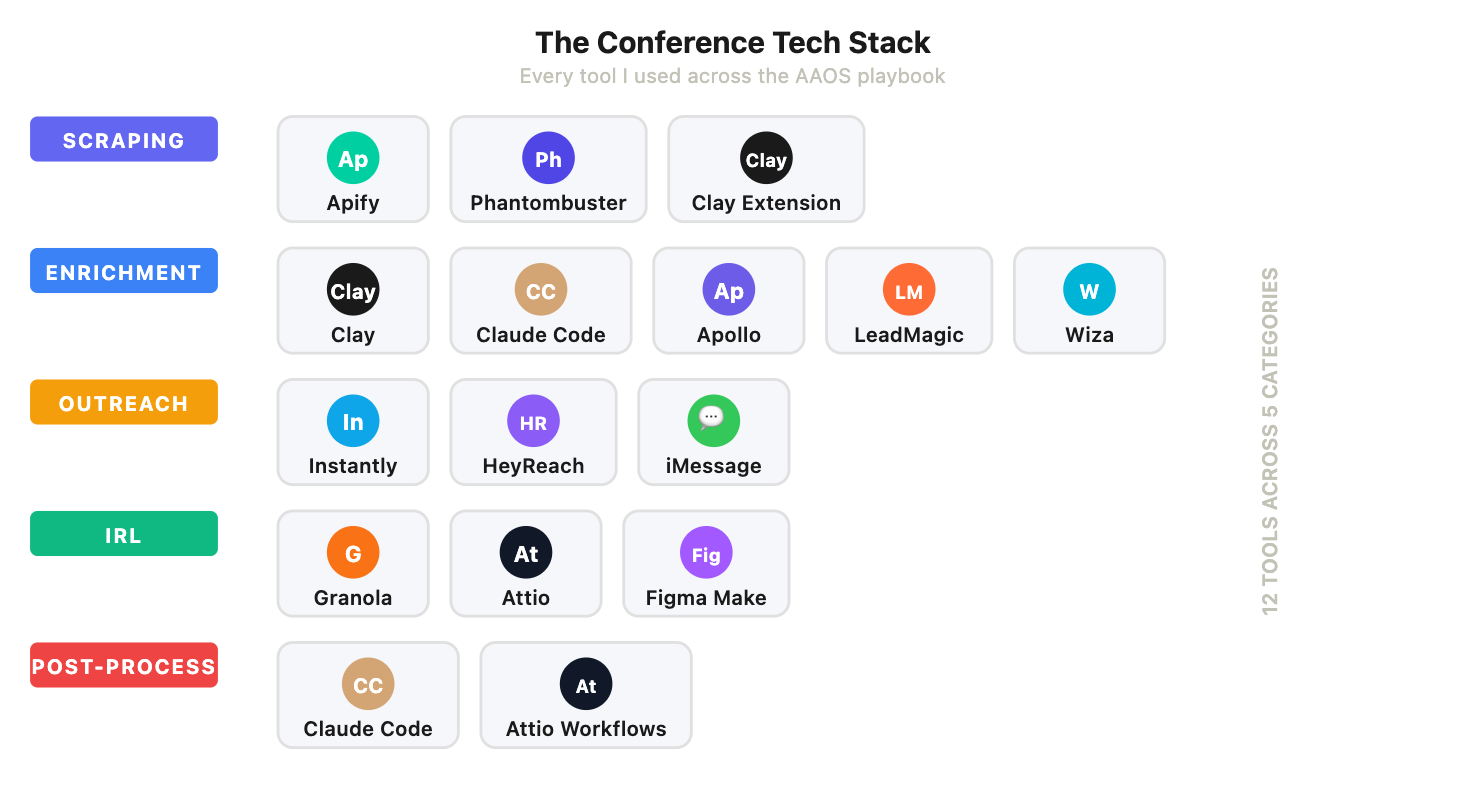
The Conference Tech Stack
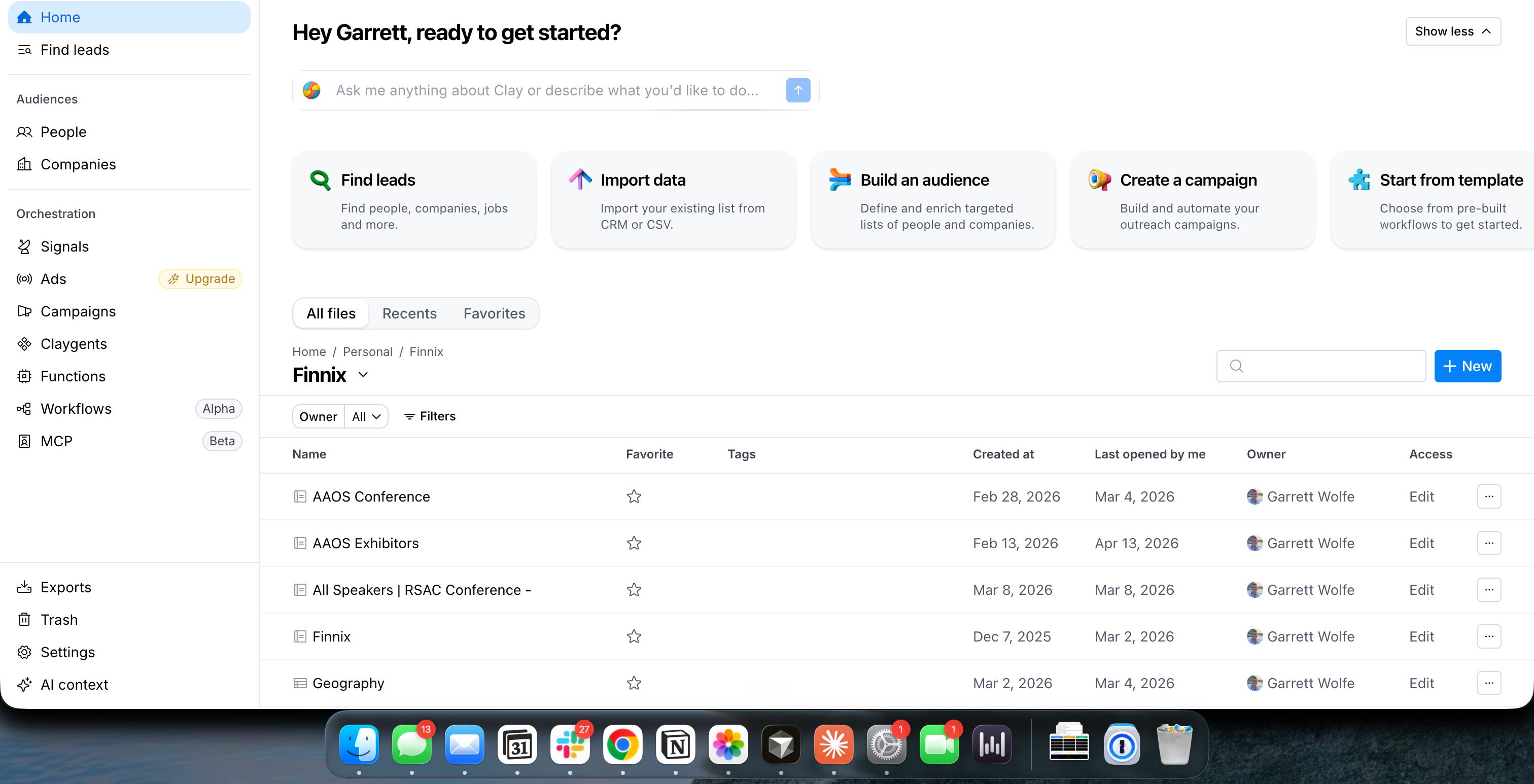
Scraping: Apify, Phantombuster, Clay Chrome Extension
Enrichment: Clay, Claude Code, Apollo, LeadMagic Wiza (for phone numbers / texts)
Outreach (pre/post): Instantly (email), HeyReach (LinkedIn)
At the conference: Granola (call recording/notes), Attio (CRM updates), your phone’s native texting, Figma Make (or prototyper)
Post-processing: Claude Code to batch-summarize Granola notes and update CRM, Attio Workflows to trigger follow-up sequences
The End
Most teams show up to conferences with no system and leave with a stack of business cards. There’s a full playbook here that few teams actually take advantage of. They buy a booth and cross their fingers. If done right, this can be an incredibly dense and powerful channel
Garrett